
This Hub Guide is an introduction to assist anyone dealing with a grid constrained site. The Guide covers some background to how the network operates, why grid constraint occurs, some potential solutions and what steps you can take.
Resource
This is a test banner
This Hub Guide is an introduction to assist anyone dealing with a grid constrained site. The Guide covers some background to how the network operates, why grid constraint occurs, some potential solutions and what steps you can take.


This Hub Guide is an introduction to assist anyone dealing with a grid constrained site. The Guide covers some background to how the network operates, why grid constraint occurs, some potential solutions and what steps you can take. The Energy Hub has developed a series of Hub guides which are available on our website www.energyhub.org.uk . This includes Guides 5 – 7 about the power network. If you have any further enquiries after reading the guides, please contact info@energyhub.org.uk .
The UK electricity system comprises generators and consumers. These are linked together by the national transmission network managed by National Grid, and regional distribution networks managed by Distribution Network Operators (DNOs). The power network operates to strict performance standards, both for frequency and voltage, from generation to the point of consumption. The local network experiences specific load imbalances that affect the operating conditions at certain times of the day and seasonally, for example on cold winter evenings.
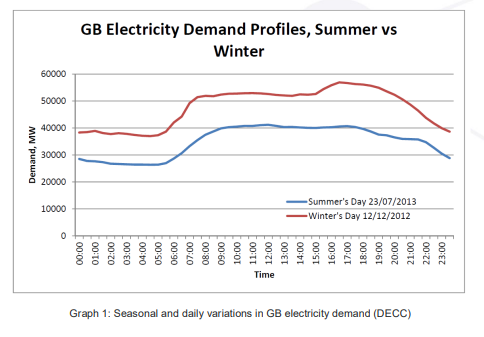
This creates fluctuation and imbalance in the network. These imbalances cause heat problems in the cables and transformers, which create both inefficiencies and network supply disruption. This may result in the consumer experiencing power supply loss (blackouts), equipment malfunction or a drop in performance due to reduced system voltage (brownouts). The variability of these conditions is dealt with through several national and local mechanisms:
Planned improvement of the network is managed under the RIIO1 price control agreement mechanism, which operates between each network operator and the energy regulator, Ofgem. These improvement costs are built into consumer electricity tariffs and are broken down according to which part of the network is incurring the cost.
Unplanned upgrades are either funded by the network operator or by those applying for a supply or export connection or wishing to change their current load requirements. The Electricity (Connections Charges) Regulations 2002 set out the rules where a request is made for a new or altered electrical connection. If the request requires reinforcement of the network (e.g. the installation on the network of upgraded cabling, transformers or other works) the cost is assessed by the network operator and allocated between itself and the applicant. Charges that are fully funded by the applicant include new cables and substations installed for the customer. Charges that are part funded are normally the cost of reinforcing the network to allow for the customer’s connection.
Some of the outlay can be recouped when new customers connect to the upgraded part of the network, using a mechanism termed the second-comer principle, based on the new customer’s connection application fee. These second-comer application fees may be passed on to the first customer or retained by the DNO, based on what was funded by who during the original upgrade, and how much new load is being requested. This arrangement is time-limited, as is the charge for any new connections, with specific timescales agreed with the network operator. Changes to the regulations in 2017 take account of the situation where an Independent Connection Provider (ICP) has undertaken the work.
Network improvement costs can in certain cases cost several million pounds, should the new connection application result in the need to upgrade the distribution network or the distribution network-transmission grid interface. In addition, since the DNO is not allowed under Ofgem RIIO rules to upgrade ahead of need, there could be a delay of months or years, should the applicant decide to wait for the upgrade to be completed as part of the DNO’s planned improvement programme.
The DNO operates a waiting list for connections, termed committed reserve. This arises where offers for a new connection have been made by the DNO, which is then obliged to allow the applicant time to agree for the work to proceed. Specific applications are commercially confidential; as a result, new applicants may be aware that they are in a queue without knowing who is ahead of them, or for how long that committed reserve will be held pending action.
There are solutions which can be applied now or will become commercially viable and acceptable as alternatives to traditional reinforcement of the network.
Reducing electrical demand should always be a key consideration for those designing or refurbishing sites (i.e. buildings and associated site infrastructure, plant and equipment) so that the connection cost can be kept to a minimum. This can be achieved through a range of site design, building-fabric efficiency and control measures for all areas of electrical consumption. A simple example is better building-insulation measures, or design orientation to capture or dissipate electrically-generated heat passively to avoid mechanical cooling.
The electrical function of the building can be managed using a Building (Energy) Management System (BEMS or BMS) which can integrate monitoring and performance data with active, automated demand management. These systems can be managed by an on-site server, or (increasingly) be cloud-based and managed remotely to meet set performance criteria. Building and property managers can realise operational, financial and carbon-saving benefits, by making sure that their building management system keeps the building working efficiently and to agreed conditions that are appropriate to its use.
Many domestic and small business consumers can already manage their building’s performance themselves, with the introduction of monitoring and control using a smart meter. This can be achieved in a variety of ways, to deliver energy, carbon and cost savings. The simplest technique for consumers is to use time switches to change the profile of demand, to help move consumption from peak tariff period, to a period of the day when tariffs are lower.
This approach can be applied during the design of new developments, or where developments are seeking more power from the grid beyond their current connection capacity. The idea is to manage potential imbalance, by creating mixed-use developments with different consumption profiles, which are complementary and when brought together, create a smooth load profile at the nearest sub-station.
Building operators can use locally-generated power, for example solar or wind, rather than import power from the local network. This could take the form of power generation located on-site and connected into the building’s electrical system on the customer side of the consumption meter (termed behind the meter). Alternatively, a private wire connection could be employed, which involves installing a cable from a source of generation directly to the point of power consumption. The demand could be an individual building, a single consumer with several buildings, or a range of users located close to each other.
Depending on the demand, the generation offsets some or all the grid power that would usually be used by the consumer. This approach can work out cheaper than securing additional connection capacity, but there are legal, commercial and technical disadvantages.
It may be possible to share a connection with one or more parties. This could be an appropriate solution, for example where there is an existing nearby connection which has spare capacity, or where there are multiple developments, each seeking a connection. This approach could also allow the opportunity to connect to local energy generation through an additional private wire arrangement. It is already commonplace, particularly for new housing and commercial developments, to develop a private distribution network. This then connects to the DNO network, with the responsibility of meeting the regulatory and technical standards up to the connection point, falling to an Ofgem-licensed Independent Distribution Network Operator2 , which undertakes the local role of the regional DNO.
Third party companies offer services which aggregate demand management across individual consumers, selling this aggregation into the Flexibility Services Market3 . The aggregator installs active control and monitoring to be able adjust the performance of electrical equipment located on the local network, typically in response to network demand. This approach can deliver benefit for the network, as well as generating consumer cost savings and revenues.
Some energy suppliers offer variable tariffs to incentivise consumers to change their pattern of energy use (termed their power profile) to times when their tariff is lower. An example of variable time of use tariffs is offered by Agile Octopus, who go further by trying to match local demand and generation.
Where new generation could cause major network imbalance, DNOs may address this by offering flexible connections. The DNO’s connection offer is conditional on the generator either turning down or stopping export of power when there is a network imbalance. In return, the generator can secure a connection where traditionally the DNO would have refused to grant one. This approach can be applied in reverse for certain consumers, who may be prepared to accept a disrupted supply in return for access to the network.
Some DNOs are also offering to pay local generators and consumers for additional local flexibility, to help balance the network in areas of significant constraint. The benefit to the local generator or consumer is additional revenue or income, while the DNO can reduce stress on the system and delay the cost of investing in the network. The current Piclo Flex service is an example of DNOs offering contracts for flexibility in areas of significant constraint that occurs during winter evenings.
A smart grid is an electricity network that can intelligently integrate the actions of all users connected to it – generators, consumers and those that do both (called prosumers) – to efficiently deliver sustainable, economic and secure electricity supplies. The key elements of a smart grid are:
This can be applied to a small part of the network called a microgrid. This is a local energy grid with control capability, which means it can disconnect from the traditional grid and operate autonomously for periods of time, although a grid connection will continue to be required in most cases unless the scheme is fully independent (termed islanded). The key benefits of this approach are:
These benefits should result in:
Some of the approaches set out above are already available to you, even if your site does not face a grid constraint. However, where there are connection challenges, whether to add new load or generation to the network, the DNO will need to know your requirement in kVA or MVA4 . Therefore, it is worthwhile having an early discussion with the DNO, along with obtaining any specialist advice from a qualified electrical engineer, to anticipate any network issues that could affect your development.
All DNOs provide various forms of heat maps, which provide customers with an indication of how easily they would be able to make a connection in any DNO area. This is done by indicating the capacity that is available and any constraints that apply. Information on available capacity is set out in each DNO Long-Term Development Statement (LTDS). This provides useful information on substation loadings and fault level in a standard tabular form, primarily for 33kV and 132kV voltages. Both are freely available through the respective DNO website and are a useful indication of whether you are likely to encounter a connection constraint.
DNOs generally provide surgeries, where customers can meet with DNO design staff to look at specific areas and gain an insight into the likely costs to connect, before making a formal application. Some may cater for ad-hoc requests for advice. This may be a charged-for service.
Some DNOs may also encourage an optioneering approach. This allows customers to submit several different capacities for the same site and receive budget costs, allowing a preferred option to be progressed to a formal offer.
DNOs themselves are undergoing transformation to become active network managers, called Distribution System Operators . Currently the DNOs control and maintain the distribution networks. Under the DSO model, the operator will take a more active role in managing local electricity generation and use. Under this new model, the DSO securely operates and develops an active distribution system, which comprises networks, demand, generation and other flexible, distributed energy resources.
NOTE: Early dialogue with your DNO is vital to be able to assess whether you can use these techniques in your circumstances. Specialist advice should always be sought from a suitably competent professional.
The following steps may help you develop a strategy to alleviate unnecessary grid upgrade costs:
You can find contacts and tool details for each DNO here
Designed to aid Local Authorities in developing robust, evidence-based plans to enable Net Zero.
Already have an account? Login
 Guest preview of selected publicly available resourcesFull library of 1,000+ articlesCPD accredited e-learning coursesCase studiesDiscussion forum