
Solar arrays and farms require supporting technology to enable the capture and use of generated electricity.
Resource
This is a test banner
Solar arrays and farms require supporting technology to enable the capture and use of generated electricity.
Provided by: Net Zero Go


There are three main types of solar installations: on-roof, canopy, and ground-mounted. There are other types such as wall or façade hung but these are fairly uncommon in the UK.
Solar panel mounting refers to methods where solar panels are secured into place to keep them safe from wind and snow loads. For domestic and commercial building applications, the most common kind of solar panel mounting is an on-roof system. As the name suggests, the solar panels fix directly onto the roof. On-roof solar panels are a cost-effective solution, providing excellent ventilation to the panels and optimal performance. Depending on the roof structure and roof covering, a number of options are available for securing panels: flush mounting, tilted mounting, and ballasted mounting.
Domestic rooftop systems |
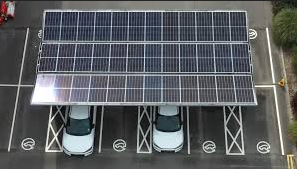
Commercial roof and canopy systems |
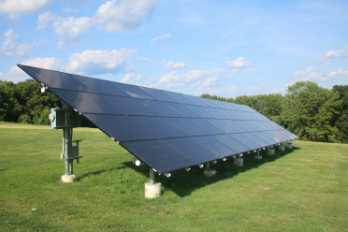
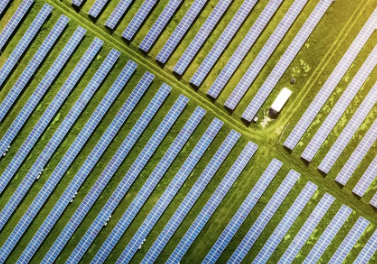
Ground-mounted arrays |
 |
 |
  |
On-roof solar panelsFor most domestic solar installations, the panels are usually secured through a hook, which goes under the roof tiles and is screwed to the roof rafters. A mounting rail system is then attached above the roof on the hooks onto which the solar panels are installed. There are a range of specialist systems for niche applications and roof types. In-roof solar panelsIn-roof solar, or integrated solar panels are the ideal solution for new builds or anyone looking to re-roof a house. In-roof systems can have sleeker aesthetics and may be desirable in conservation areas. As the solar panels sit snug within a tray, there is no space for birds to nest underneath, and the panels appear flush with the rest of the roof. However, this does result in less air ventilation around the panels, resulting in a 5-10% lower efficiency. |
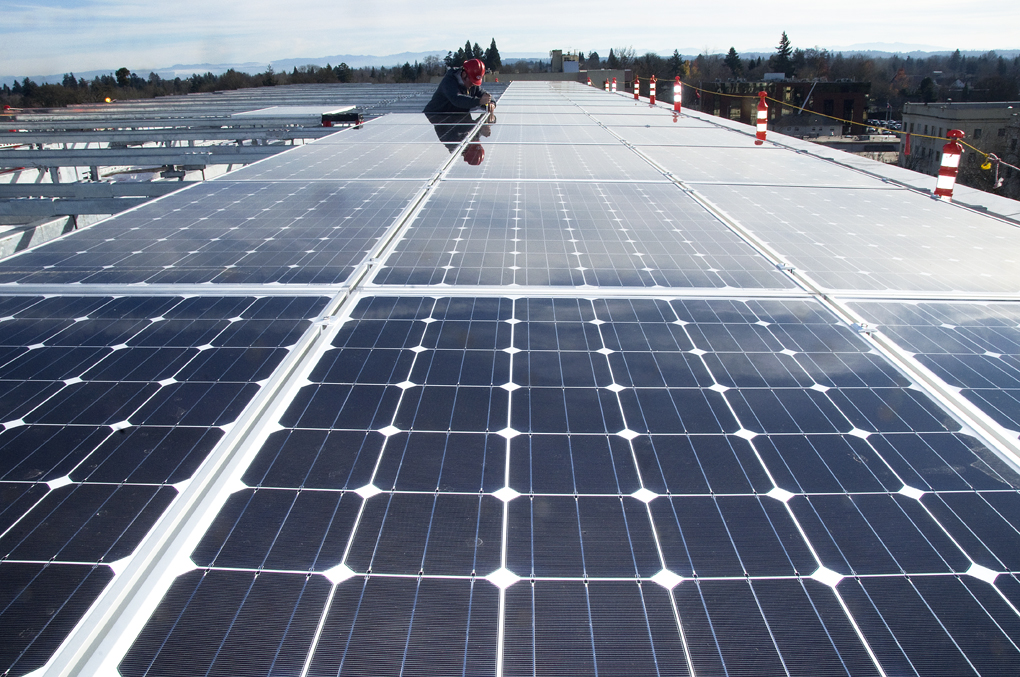
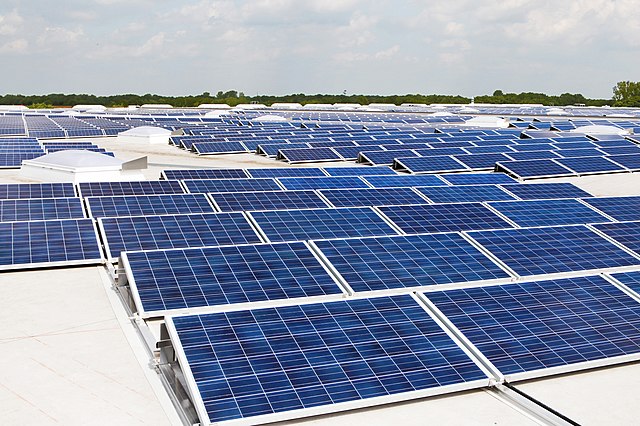
On-roof solar panels (commercial)Commercial solar panels can be beneficial regardless of whether your organisation is large or small. Most businesses are active in the daytime, which means they are the perfect candidates for utilising solar panels and enjoying the cost savings that come with them. Solar canopies (car parks)The large, flat, open and often under-utilised surfaces of car parks make them ideal locations for solar power generation. Modern designs and construction methods mean that any type of car park can accommodate an effective and aesthetically pleasing solar power station. Solar panels in car parks can also power electric vehicle (EV) charging. This works especially well at offices, where employees' cars are parked outside for many hours. Shopping centres, football stadiums, leisure centres, and cinemas are also suitable venues, since cars tend to be parked for two hours or more to allow sufficient charging. |
Ground-mountedLarge arrays are most often installed as ground-mounted systems; this includes very large solar farms. Solar ground-mounted systems serve a number of purposes. They need to secure and support the solar panels, carry cables and electrical services from the panels, and in some cases be able to resist any animals (such as cows, sheep, or rodents) that may be able to access the array. Fixed solar PV mounting systems offer simplicity, reliability, and cost-effectiveness for both roof and ground installations. |
Solar panels need to be secured to a structure of some kind to make sure that they won't blow away, can take snow and rain loading, and can be installed at an optimum angle for energy generation. There are a number of installation methods used depending on what the panels are attached to.
Flush mounting |
Tilted mounting |
Ballasted mounting |
Ground-mounted |
 |
 |
 |
 |
|
This is the simplest and most common method of roof mounting. Solar panels are installed parallel to the roof surface using racks or mounting brackets. They are positioned close to the roof to minimise wind resistance and maintain a sleek appearance. Flush mounting is suitable for roofs with sufficient space and a compatible orientation (south-facing is optimal for maximum solar exposure). For a flat roof, this may not be desirable due to the non-optimal energy production. Installing solar PV onto a trapezoidal metal roof is one of the cheapest and fastest means of deploying solar panels. The rails are instead secured to the ridges of the metal roof by self-tapping screws. This keeps the solar PV panels very close to the roof, minimising any impact that the wind may have. What’s more, as these clamps have a rubber backing, the system is waterproof. |
In some cases, solar panels may be mounted at a slight tilt to optimise solar exposure. Tilted mounting brackets or racks are used to angle the panels towards the sun, typically at an angle equal to the roof's latitude. This can improve energy production. |
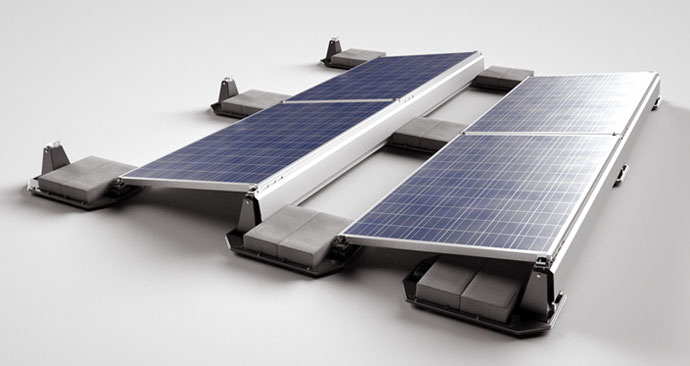
Ballasted mounting systems are commonly used for flat commercial rooftops where penetration of the roof membrane is not desired. Solar panels are held in place using weighted ballasts, such as concrete blocks or precast concrete pavers. This method avoids roof penetrations and is relatively easy to install and remove. This does require more weight on the roof than other systems and a full structural survey may be required to ensure that the roof structure is able to support the ballast. |
Ground-mounted systems can be secured in a couple of ways. Concrete foundation mounting: Ground-mounted solar PV systems can be installed on concrete foundations, which provide stability and durability. Steel or aluminium mounting structures are anchored to the concrete foundation, and solar panels are attached to the mounting frames. This method is suitable for larger-scale installations on open land or fields. Pile-driven mounting: Pile-driven mounting systems involve driving steel posts or piles into the ground to support the solar panel array. The posts are typically spaced at regular intervals and anchored securely to provide structural stability. This method is commonly used in areas with soft or uneven terrain where concrete foundations may not be feasible. |
Designed to aid Local Authorities in developing robust, evidence-based plans to enable Net Zero.
Already have an account? Login
 Guest preview of selected publicly available resourcesFull library of 1,000+ articlesCPD accredited e-learning coursesCase studiesDiscussion forum