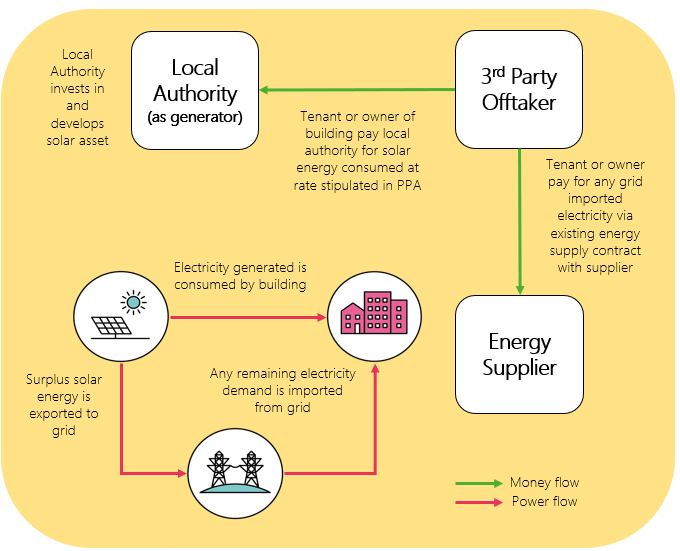
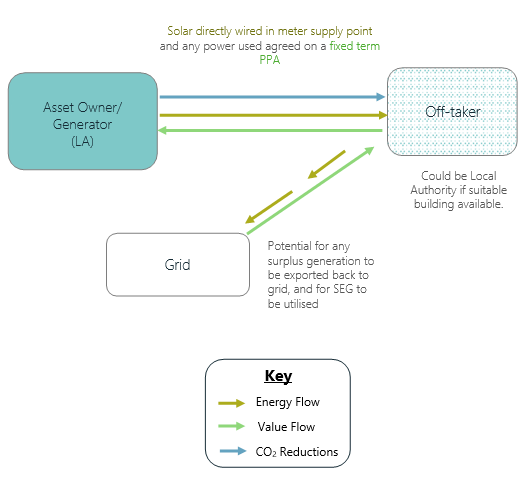
In the private wire business model, a solar asset is directly connected to the point of offtake and electricity generated is used to satisfy site demand
In the private wire business model, a solar asset is directly connected to the point of offtake and electricity generated is used to satisfy site demand. Surplus solar generation is exported to the power grid.
A private wire is sometimes referred to as a ‘Behind the Meter (BtM) PPA
This model can be enacted by local authorities as follows:
Local authority designs, builds and commissions solar generation asset on/ near building.
Capital and operating costs are recovered through a PPA with a third-party offtaker (most likely a tenant in a local authority owned building but this does not always have to be the case).
The third-party offtaker pays for any grid imported electricity through their existing supply contract.
The local authority may generate additional revenue from surplus solar export.
This will require an additional export arrangement with a balancing responsible party.
A private wire is where a generator connects directly to a building or site, replacing any power they would have imported
A private wire is not subject to the same regulation and charges (e.g. use of system or policy charges) that standard exported electricity would face
This is highly valuable for both parties depending on the cost of setting up the private wire:
For the off-taker, they will have to import electricity as normal when there is not any power available from the private wire
For the generator, anytime there is not sufficient demand from the off-taker, the excess power will be exported onto the grid which requires separate commercial
Key Benefits
Financial and CO2
Decrease in energy bills for off- taker
Uplift in price for generator
Reduces carbon emissions for off- taker through reduced import from grid
Other Benefits
Long-term price security for generator and off-taker
Local skills and jobs
Can be expanded with additional capacity at good site locations
Risks and Considerations
Complex to deliver
Requires suitable locations and demand close to generator
“Optimism bias” – can suffer from poor initial cost estimates and spiralling costs
Value from avoided system and policy costs likely to be removed in future
Very difficult to find sites of sufficient size next to an off- taker
Cost of setting up the private wire
Suitable for
Technology – primarily solar, storage could be included in future
Schemes with a large baseload which is guaranteed over time
Sufficient network and grid connection capacity, so that the off- taker does not incur any upgrade costs
Suitable land needs to be available in the area, where generation can be placed close to demand and create limited issues in terms of planning consent for the private wire
Contracts Required
Direct PPA – if the generator and off-taker are different parties
Contract with Electricity Supplier – off-taker contracts with electricity supplier for balance of electricity
DNO – Grid Connection Offer and agreement to be in place
Construction & Legal – construction contract for generation, installation and for “Private Wire”. Legal contracts to fulfil third party land rights and H&S
Operational – Operational contracts for running and maintenance of “Private Wire”
Contractual Considerations
Specifying the requirements for the private wire is a specialist skill and will require a proper engineering review of the proposed route to identify additional challenges
It is likely that the generator would be an exempt supplier under the Supply Licence Exemption Rules – but specialist advice on this should be sought by the project
Connection arrangements can become complex as the generator will generally not be allowed to connect to the grid other than at the off- taker’s site
Business Model
Viability
Cost Structure and Revenue
In a private wire arrangement, a solar generation asset is directly connected to the source of off-take.
This is different to the Sleeved PPA model where power is first exported to the grid and then ‘sleeved’ to the offtaker.
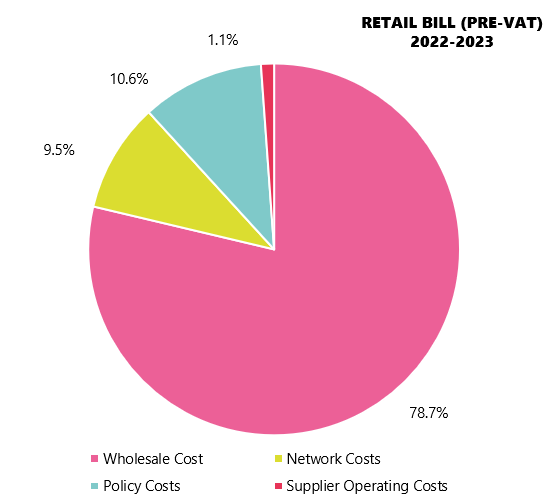
A private wire connection offers cost-savings on the wholesale cost of electricity. – Under current regulations, additional cost-savings may also be achieved by avoiding network charges and environmental and social obligation (policy) costs.
To illustrate these cost-savings, the pie chart on the right highlights components that make up a retail electricity bill in terms of their percentage contribution.
When setting the price for a private wire PPA, the benefits of these savings are shared between the generator and the offtaker. The generator should generate more revenue than if they were trading on the wholesale market and the offtaker should pay a lower price for electricity than what they would as per their existing retail electricity bill. The generator’s revenue will be used to pay financing (loan repayment) and operational costs.
Please note that these component costs are not fixed. The percentages shown may differ year on year. This diagram is for illustrative purposes only.
When negotiating how the benefits from cost avoidances should be shared between the generator and offtaker, the following factors should be considered:
1.What IRR is required by the generator?
If a high IRR is required, the private wire power price will be closer to the retail price.
2.What cost-savings are required by the offtaker?
If the goal is to maximise cost-savings for the offtaker, the private wire power price will likely be closer to the wholesale price.
3.Will there be a ‘take or pay’ clause stipulated in the contract?
If so, this could reduce the financial risk for the generator and, in turn, a lower private wire power price may be negotiated
Generator Benefit
Generator receives payment for power generated; referred to as the ‘Private Wire Power Price’. This should be greater than the wholesale cost of electricity on a p/kWh basis.
Like the Sleeved PPA model, at times, this price may look less attractive than the wholesale price for electricity.
When generation is greater than demand, additional revenue may be generated by exporting surplus energy to the grid. This will require an additional export agreement.
Offtaker Benefit
Offtaker pays for electricity at a price that is higher than the wholesale cost of electricity yet still lower than the retail price of electricity.
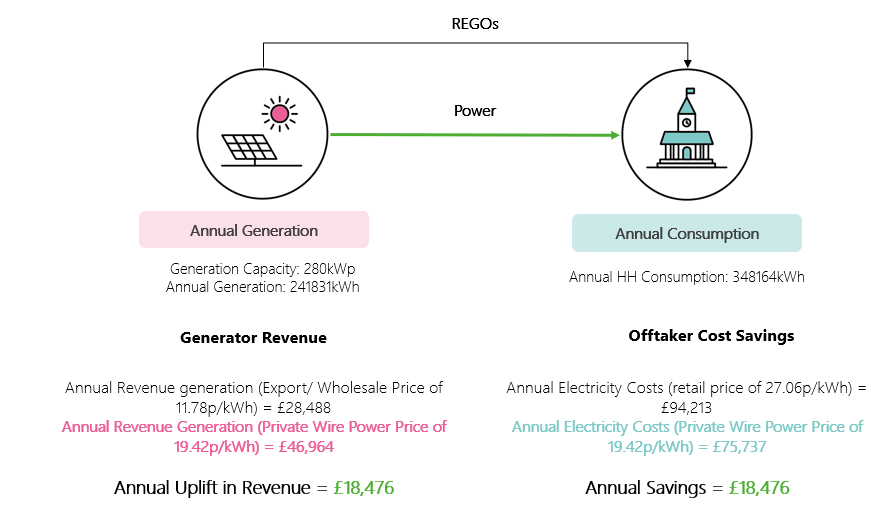
An Example
Using data from an example project, the image below illustrates the potential financial benefits of the Private Wire business model for both the generator and offtaker.
The cost avoidance benefits are shared 50:50 between both Parties.
For simplicity, it is assumed that 100% of the power generated is used to satisfy ~69% of the site’s total demand. However, as mentioned, this would not be the case due to seasonal variations in both solar generation and power demand.
Other Considerations for viability
The commercial viability of private wire business models can be enhanced by the avoidance of policy and network costs
This means that the business model is exposed to policy and regulatory risk
Several initiatives that may influence the level of cost avoidance achieved through private wire projects in future are outlined in the table to the right
Although it is not yet known how these initiatives (and their possible outcomes) may influence the commercial viability of private wire projects, it is important for local authorities to stay up to date on policy changes that may impact the business model
It is also important that commercial models for private wire projects are frequently updated to reflect any changes to policies and regulations
Initiative
Brief Summary
Retail Bill Electricity Bill Component of Relevance
DESNZ – Review of Electricity Market Arrangements (REMA) (DESNZ, 2023a)
The wide-ranging review will identify reforms needed to transition to a decarbonised, cost effective and secure electricity system.
Policy and Network Costs
DESNZ – Electricity licence exemptions call for evidence (DESNZ, 2023b)
This call for evidence seeks to understand how exemptions are currently being used and whether changes are needed to reflect policy aims, in particular, ensuring all market participants (including licence exempt) pay their ‘fair share’ of policy and network costs.
Policy and Network Costs
DESNZ – Powering Up Britain Report (DESNZ, 2023c)
UK government committed to outlining a clear approach to gas vs. electricity ‘rebalancing’ by the end of 2023/4 and should make significant progress affecting relative prices by the end of 2024.
Policy Costs
Transmission Network Use of Systems Charges (TNUoS) Task Force (Charging Futures, 2022)
The Task Force will examine various aspects of TNUoS methodology, including which elements of TNUoS charges should be paid by distributed generators with a clear, system-based rationale for any differences in treatment between classes of generators.
Network Costs
Ofgem – Distribution Use of System Charges (DUoS) Significant Code Review (Ofgem, 2022)
The review will consider numerous aspects of DUoS, including principles and trade-offs in network charging; distributional impacts, vulnerability, and fairness; and what signals get sent and to whom?
Network Costs
Feasibility
Key Partnerships
Generator
Designs, develops, constructs, and oversees the operation and maintenance of a renewable generation project (some of these activities may be outsourced to third-party organisations).
Owns the asset(s) of a renewable generation project.
DNO
Provides grid connection offers and grid connection agreements for sites (depending on the stage of project delivery).
Funding/ Finance Provider
Advises on eligibility, loan structures and repayment terms.
Provides the necessary funds to cover project costs through a contractual agreement with the generator.
Offtaker
Purchases and directly consumes electricity from the generator (asset owner) of the renewable generation asset(s) through a Private Wire agreement.
Energy Supplier (and/or other BRP)
Purchases surplus solar energy that is exported to grid from the generator.
Provides a potential route to new flexibility markets (which could be offered from the DSO or ESO).
Delivery Contractor
Responsible for the design and/or build of the renewable generation project (depending on the delivery approach chosen)*
Some delivery contractors may also take on O&M responsibilities.
Some activities may be subcontracted to other companies.
Legal Advisor
Provides legal guidance on the contractual elements of project delivery (e.g., private wire contract and supply licence exemptions).
O&M Contractor
Responsible for managing the operations and maintenance of a renewable generation asset on behalf of the generator.
Some activities may be subcontracted to other companies
Decommissioning Contractor
Responsible for the decommissioning of the renewable system once it has reached the end of its usable life.
Responsible for repurposing the site.
Some activities may be subcontracted to other companies.
Partner Arrangements
To enact this model, a private wire agreement between the generator and offtaker that stipulates key terms (e.g., power price, volume and contract duration) will be required.
An additional commercial agreement between the generator and a balancing responsible party (BRP) will be required for any surplus solar energy exported to grid.
If the asset is under 5MWp, it may be eligible for Smart Export Guarantee.
Potential offtakers will be identified during site selection activities – this may or may not be a local authority owned site.
The opportunity for a local authority to secure a private wire arrangement as an offtaker will depend on the proximity of the local authority’s site to the renewable generation site and how well generation and energy demand profiles are matched.
Contract Length
Because the solar generation asset is directly connected to the source of consumption, viability of the private wire business model is primarily dependent the price paid for energy by the offtaker across the lifetime of the asset.
This means that long-term contractual arrangements (c.15 years) are often required.
Please note that although contracts have ranged up to 15 years in the past, more recently, they have been shorter.
Long-term contracts can provide revenue certainty but may be harder to obtain under current market conditions.
Energy Volume Considerations
The generator should make clear to the offtaker the anticipated volume of energy that will be supplied to the site (taking variability and asset degradation into account).
To reduce supply risk, the offtaker may wish to include a ‘minimum supply volume’ clause in the contract that outlines penalties for the generator if the asset does not perform as expected.
It is also possible that the offtaker’s energy demand profile may change over time (due to operational changes or the installation of energy efficiency technologies).
To minimise revenue risk, the generator may wish to include a ‘take or pay’ clause in the contract.
This means that the offtaker would agree to a stipulated volume of energy and pay a penalty if it is not consumed onsite
Key Activities and Key Resources
Site Selection and Grid Connection
When identifying potential site locations for private wire schemes, the length of the private wire connection required is a crucial factor to consider.
Costs for a 1km private wire connection can be up to £250k* (see Appendix 3) (Energy Local Scotland, 2020).
It is also important to know the energy demand of potential sites that are being considered to understand how well energy generation and demand are matched.
It is good practice to perform calculations, to understand the percentage of self-consumption, as accurately as possible (and as soon as possible in the design process) to minimise any unforeseen costs (i.e., due to potential resizing requirements) and to avoid unnecessary project delays.
For private wire installations, consideration needs to be given to where the scheme will connect to the grid (e.g., at the offtaker’s site or at the generation site).
The most common arrangement is for the grid connection point to be located at the offtaker’s site.
This means that the offtaker can still have a separate supply arrangement with an energy supplier which may be required for the following reasons:
To supply energy to match any site demand that can’t be met by solar asset output.
To account for any planned (or unplanned) shutdowns.
Where this is the case, the generator should consider what contingencies they need to have in place should access to the grid connection point become no longer available (i.e., the offtaker moves premises).
If the grid connection point is located at the generation station, the DNO may require this to become the offtaker’s only point of electricity supply (Welsh Government Energy Service, 2021).
This could result in energy supply risks for the offtaker (depending on how well-matched generation and demand profiles are).
Energy Supply
Licencing
To supply electricity to an offtaker, via Private Wire, the generator would either need to be a licensed electricity supplier or fall under one of the exemptions in The Electricity (Class Exemptions from the Requirement for a Licence) Order 2001 (HM Government, 2001).
Legal support will be required to determine whether compliance has been met and which Class exemption is applicable.
Excess power generation
There may be times that excess power is generated from the solar asset and needs to be exported to the grid.
This will require a separate export agreement with a balancing responsible party.
If the solar asset is under 5MWp, it may be eligible for Smart Export Guarantee (SEG) (OFGEM, 2023).
As an alternative to SEG, the generator may secure a PPA with an energy supplier for solar export.
Some local authorities have secured an export arrangement for their aggregated surplus solar at a rate higher than most SEG providers.
Soft market testing with suppliers will be required to ensure that the best possible rate (p/kWh) is obtained for surplus solar export.
End of the arrangement
At the end of the private wire arrangement, the offtaker may not wish to renew the contract.
In this case, the generator may choose to export all solar energy to the grid by securing an export agreement with a balancing responsible party.
This could be a complex process if the grid connection is under ownership of the offtaker.
For example, the generator may be required to pay rent or usage fees to continue using the connection point.
Desirability
Value Proposition, Customer Relationships, Customer Segments, Channels
Local Authority as Generator
Desirability Checklist
Considerations
Revenue Generation
Do you value revenue generation more than reducing costs?
As generator, the local authority will not benefit from cost savings as they are not purchasing and consuming renewable energy from the asset. Instead, they would have access to the following two revenue streams:
Primary Revenue Stream: Selling renewable energy to third party offtaker as per the Private Wire agreement.
Additional Revenue Stream(s): Exporting (and selling) surplus renewable energy to the grid (if applicable).
How much do you value the opportunity to maximise revenue generation potential?
The value of the primary revenue stream will be greater on a p/kWh basis. Therefore, revenue generation potential depends on how well renewable energy produced by the generator and energy demand of the offtaker are matched.
As well as the wholesale cost of electricity, under current regulations, certain policy and network costs can also be avoided in Private Wire arrangements.
The amount of revenue generated therefore also depends on how the benefits of these cost avoidances are shared between both Parties when negotiating the private wire power price.
Revenue generation potential also depends on the pricing structure adopted.
Price Certainty
Do you value revenue certainty?
Revenue certainty is influenced by the length of the private wire contract (typically up to 15 years) and the pricing structure adopted.
Longer-term contracts in combination with certain pricing structures can provide greater revenue visibility for the local authority, which could increase investor confidence.
If opting for fixed pricing structure, the local authority would not benefit financially if wholesale electricity prices rose higher than the private wire power price.
The local authority may therefore experience trade-off between revenue generation potential and revenue certainty.
Typically, generators have more negotiation power when agreeing upon the desired power price, pricing structure and contract length as they have certain financial metrics that must be achieved for project sign-off.
Risks
Are you comfortable with risk?
The private wire business model is exposed to policy and regulatory risk. Changes to existing regulations could influence what cost avoidances are achievable.
In turn, this could influence the commercial viability of the business model.
The local authority will also be exposed to counterparty risk.
As a mitigation measure, counter party due diligence can be performed to determine whether the offtaker is at risk of defaulting on payments.
This risk is especially important for private wire agreements where the primary revenue stream is dependent on the supply of energy to a particular site.
The local authority will also be exposed to some volume risk.
For example, if the local authority is unable to supply the volume of energy as stipulated in the private wire contract, they may face financial penalties.
If the offtaker’s energy demand profile changes over time, the local authority could also be exposed to revenue risk.
For example, changes to energy demand could influence how well generation and demand are matched.
This may be mitigated by implementing a ‘take or pay’ clause.
If opting for a pricing structure that is linked to wholesale electricity prices (e.g., dynamic pricing), the local authority would also be exposed to market (price) risks.
Resource Requirements
Do you have the resource and expertise available to deliver renewable generation projects?
As generator, the local authority will be required to identify suitable sites for the private wire installation.
This activity is crucial to understanding the commercial viability of the project as it will determine how well generation and demand are matched as well as the length of the private wire connection required.
Commercial modelling will also be required to understand what power price (and pricing structure and contract length) is necessary to achieve the financial metrics required for project sign-off.
Do you have access to legal support?
Legal support will be required for negotiating key contractual terms with the third-party offtaker (i.e., contract length, power price, volume).
Negotiations should also include grid connection considerations (e.g., what provisions will be put in place for access to the connection point at the end of the agreement – if the grid connection is at the offtaker’s site?).
Legal support will also be required to check whether the project complies with Supply Licence Exemption regulations.
Local Authority as Offtaker
Desirability Checklist
Considerations
Cost Savings
Do you value cost savings more than generating revenue?
As an offtaker in a Private Wire arrangement, the local authority would not generate revenue as they are not selling renewable energy to a third-party organisation.
Instead, they should achieve cost savings by purchasing electricity at a lower cost than the retail price of electricity (on a p/kWh basis).
How much do you value the opportunity to maximise cost-savings?
The amount of cost savings available to the local authority as offtaker will depend on how the cost avoidance benefits are shared between both Parties.
Unlike the Sleeved PPA business model, an energy supplier is not required to facilitate the transfer of energy in a Private Wire arrangement.
As a result, the local authority is not responsible for paying supplier (sleeving) fees.
Cost savings from a Private Wire arrangement could therefore be greater than a sleeved PPA.
Though, still, they will not be as high as those from directly offsetting grid imported electricity (which would only be possible if the local authority assumed the role of generator and offtaker).
Price Certainty
Do you value cost certainty?
Cost certainty depends on the length of the PPA contract (typically up to 15 years), and the pricing structure adopted.
Longer term contracts in combination with certain pricing structures can increase cost visibility for the local authority which can inform budgeting and forecasting activities.
The fixed pricing structure is most common and offers the greatest level of cost certainty.
Risks
Are you willing to take on some risk?
If opting for a fixed pricing structure, the local authority, as offtaker, will take on market (price) risk.
The local authority will also take on some volume risk as offtaker.
For example, the actual volume of energy available may differ to that stipulated in the Private Wire contact.
This could limit the amount of cost-savings that are available to the local authority.
To mitigate this risk, the local authority could consider including penalty clauses in the Private Wire contract in case the renewable generation asset does not perform as expected.
Resource Requirements
Do you have access to legal support?
Legal support will be required for negotiating key contractual terms with third-party generator (i.e., price, volume, and contract length).
Local Authority as Offtaker and Generator
If the local authority assumes the role of generator and offtaker, the private wire business model would essentially become a self-consumption and export model where:
Commercial viability is primarily dependent on the cost-savings achieved by offsetting grid imported electricity.
Further revenue may be generated from surplus solar energy that is exported to grid (at a lower price on a p/kWh basis).*
The table below highlights considerations for this arrangement
Desirability Checklist
Considerations
Revenue Generation and Cost-Savings
Do you value both generating revenue and reducing costs?
The generator and offtaker may be from different departments within the local authority which have different budgets.
The departments may therefore need to agree and set a price for electricity internally (e.g., it may be necessary to demonstrate that certain financial metrics can be achieved to obtain project sign off).
Where this is the case, the local authority could set the power price to whatever best aligns with the underlying objectives of the project.
There may be times where the site does not require/ cannot consume energy from the renewable generation asset.
Where this is the case, additional revenue may be generated from a commercial arrangement with a licensed SEG provider.
Price Certainty
Do you value price certainty?
As generator and offtaker, the local authority can agree upon a contract length and pricing structure that is best suited towards their appetite for risk (if necessary).
Risks
Are you willing to take on some risk?
The local authority in their capacity as offtaker will still be exposed to market (price) risk if opting for a fixed pricing structure.
In the absence of a formal contractual agreement (the Private Wire contact), volume and counter-party risks would be minimised.
Resource Requirements
Do you have the resource and expertise available to deliver renewable generation projects?
As generator a
Register to access the full article
Designed to aid Local Authorities in developing robust, evidence-based plans to enable Net Zero.




 Viability
 In a private wire arrangement, a solar generation asset is directly connected to the source of off-take.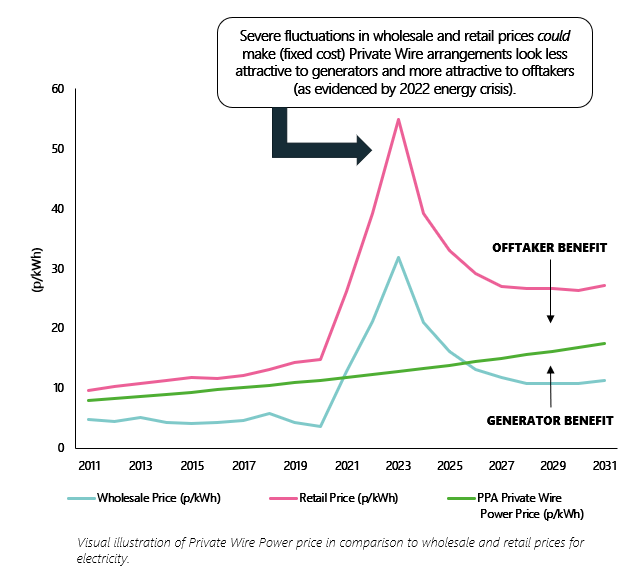
 Feasibility








 Desirability


 Value Proposition, Customer Relationships, Customer Segments, Channels
 Guest preview of selected publicly available resources