This self-assessment framework has been developed following the theory of Doughnut Economics. Doughnut Economics takes into account the social and ecological impact of human activities while developing strategic aims or projects or programmes.
In answering the questions included in each subsection, the user will need to engage with internal stakeholders spread across their organisation, stimulating a discussion on the social and environmental impact of a specific project.
As an outcome, the user will be able to communicate to internal and external stakeholders the social and ecological benefits of the project, as well as its risks.
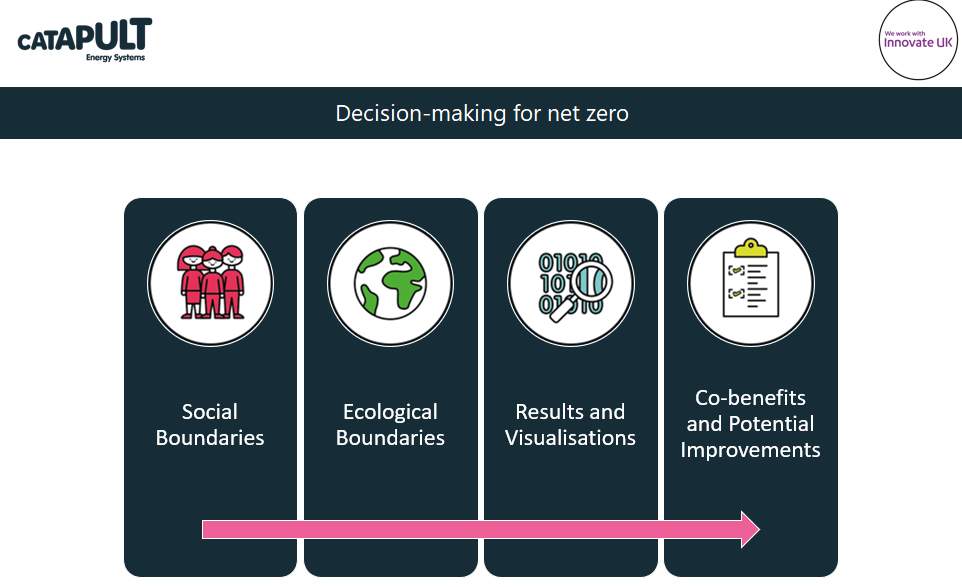
As part of the insights for local authority transformation of the UK energy system to meet carbon reduction targets, decision-making support was highlighted as a requirement for the Smart Local Energy Toolkit.
Download the Decision Doughnut Tool from the files section
One of the output tools for Net Zero Go is the Decision Making Doughnut, which will complement local authority decision-making processes by:
- Providing a visual summary of the impact of a given project
- Enforcing decision-makers to consider aspects such as the impact of decisions/projects on the wider environment
- Quantifying the impact of a given project on a relative scale allows decision-makers to observe impacts at a glance for consideration
- Embedded environmental/carbon thinking for non-energy specific projects
While this decision-making tool could be used at any stage during the lifecycle of a local authority’s projects or processes, it is recommended that the tool is primarily used at project initiation, in Stage 0: strategic definition stage. This is because communicating the impacts of a given project earlier allows them to be understood by interested stakeholders, therefore reducing the risk of progress being blocked further down the process.
During the Plan of Work process, any changes made to the project should be reflected in an updated version of the Decision Making Doughnut to keep it relevant and applicable.
This decision-making wheel is based on the Doughnut Economics model, which is a visual framework for sustainable development that combines planetary/environmental boundaries with social boundaries. These concepts of boundaries are arranged in a doughnut shape: the inner circle represents the social boundary that relates to life’s essentials, and the outer layer of the doughnut represents the planetary/environmental ceilings that life depends on, which therefore should not be breached.
In the context of local authority decision making, the slices of the doughnut have been modified to represent local authority issues.
Limitations of the tool
- This decision-making support provides only a snapshot in time of a given project and therefore future unexpected effects may not be accounted for.
- This tool will be best associated with a local authority’s current baseline view of all activities to understand how decisions made around projects may shift away from or towards Net Zero goals.
Impact rating definitions
The Doughnut Economics Tool contains two impact categories
- social Boundaries
- planetary/environmental boundaries
These 2 impact macro-categories contain respectively 14 and 10 subsections. Each subsection contains between 2 and 6 questions to support a self-assessment of the expected impact of the project.
To answer each of the questions required for the sections of the doughnut, you may need to consult key stakeholders from different departments, and evidence to support the score ranking will be required.
The demonstration impact of each section of the doughnut is scored on a scale of 1 to 5.
| Score |
Definition |
| 2 |
Extensive Positive Impact
This level indicates that the decision is likely to cause an overall long-lasting positive environmental or social impact. The extent of this impact may be assessed against scale, for example ~80% of constituents will directly benefit from this decision |
| 1 |
Limited Positive Impact
This level indicates that the decision is likely to cause some positive environmental or positive social impact but on a smaller scale compared to Level 2. This impact may last for a shorter time or positively impact fewer people (if the context is relevant) |
| 0 |
Neutral Impact
This level indicates that the decision has neither a net positive nor a net negative environmental or social impact. In other words, the positive impacts of the decision are matched by the negative impacts |
| -1 |
Limited Negative Impact
This level indicates that the decision is likely to cause some negative environmental or social impact but on a smaller scale compared to Level -2. This impact may last for a shorter time or negatively impact fewer people (if the context is relevant) |
| -2 |
Extensive Negative Impact
This level indicates that the decision is likely to cause an overall long-lasting negative environmental or social impact. The extent of this impact may be assessed against scale, such as the number of people who will be negatively affected. An example of environmental impact is increased traffic and hence emissions/pollution as a result of this decision |
Questions in the tool
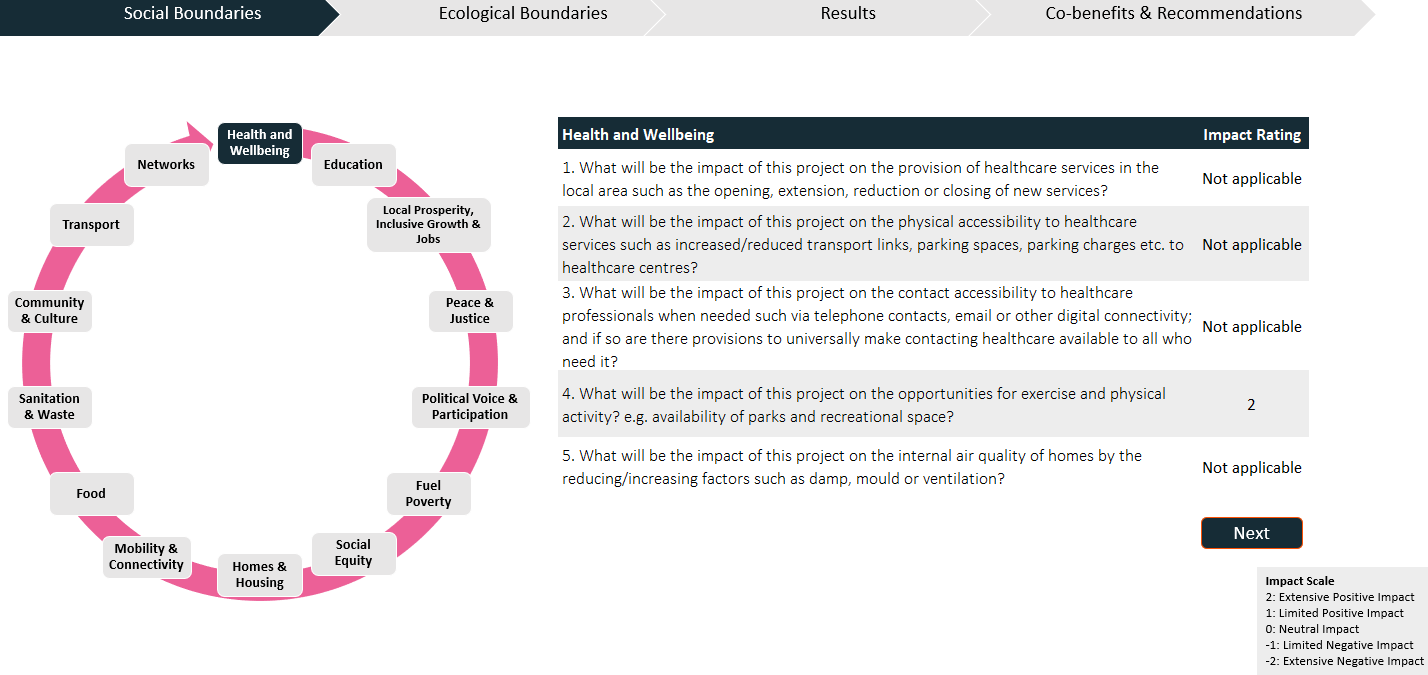
Inner boundary sections & definitions
| |
Social boundary section |
Questions to answer |
| 1 |
Health and wellbeing
This section is related to services which provide healthcare support to people in the community such as hospitals/GPs/dentists, nursing homes, foster care/adoption services, nurseries and mental health provision. |
- What will be the impact of this project on the provision of healthcare services in the local area such as the opening, extension, reduction or closing of new services?
What will be the impact of this project on the physical accessibility to healthcare services such as increased/reduced transport links, parking spaces and parking charges?
What will be the impact of this project on access to healthcare professionals such as via telephone contact, email or other digital connectivity? If there will be an impact, are there provisions to make contacting healthcare professionals available to all who need it?[[HW4]
|
]
What will be the impact of this project on the opportunities for exercise and physical activity such as availability of parks and recreational space?
What will be the impact of this project on the internal air quality of homes by reducing/increasing factors such as damp, mould or ventilation? |
| 2 |
Education
This section is related to services which provide classes, programmes, training or activities for teaching and learning a variety of subjects – formal or vocational – to improve skills and knowledge. |
- What will be the impact of this project on the provision of opportunities to educate locals on the impact of climate change?
What will be the impact of this project on the provision of opportunities to educate locals on sustainable energy consumption?
What will be the impact of this project on the provision of educational services in the local area such as the opening, extension, reduction or closing of new services?
What will be the impact of this project on the provision of opportunities for informal education such as historical sites, heritage and art programmes?[[HW5]
|
]
What will be the impact of this project on the demand for formal education places: primary, secondary, further education? |
| 3 |
Local prosperity, including growth & jobs
This section is related to opportunities that will affect the residents of the local authority financially such as job availability, as well as schemes that will bring financial benefit to the local authority which can be passed on to residents. |
- What will be the impact of this project on the income of the local authority by increased/reduced revenue, increased/reduced bills and property maintenance costs for local community buildings etc?
What will be the impact of this project on employment opportunities for local residents?
What will be the impact of this project on the working conditions of employees in the local area?
What will be the impact of this project on trade opportunities for local businesses?
What will be the impact of this project on revenue of local businesses by increased/reduced energy bills?
What will be the impact of this project on the provision of part- or full-owned community assets?
What will be the impact of this project on residents financially (outside of employment opportunities) such as an impact on state benefits or a change in the local cost of living?
|
| 4 |
Peace & justice
This section is related to services which provide community safety and crime reduction and deterrent measures such as street lighting, neighbourhood policing and partnership with national and local police services. |
- What will be the impact of this project on security deterrents such as street lighting, law enforcement presence, CCTV?
What will be the impact of this project on the way in which crimes (serious and petty) are reported?
What will be the impact of this project on the number of crimes committed locally?
What will be the impact of this project on antisocial behaviour such as noise nuisance, vandalism and harassment?
What will be the impact of this project on the availability or production of high-value assets which may be prone to theft?
|
| 5 |
Political voice & participation
This section is related to services to engage the local community and businesses in forums (in person or remotely) to allow consultation on local issues that require community insight. |
- What will be the impact of this project on the participation of local residents and businesses in local decision making?
What will be the impact of this project on the representation of local opinions?
What will be the impact of this project on local political participation – including local elections?
What will be the impact of this project on how local people and businesses present their views?
|
| 6 |
Fuel poverty
This section is related to the affordability of energy to keep residents’ homes adequately heated – it may be defined as the proportion of household income spent to keep homes at a reasonable temperature. |
- What will be the impact of this project on the cost of energy to vulnerable residents (including the provision or removal of subsidies and other assistance levers)?
What will be the impact of this project on the accessibility of energy to vulnerable residents (such as the availability of pre-payment top-up shops, direct connection to the grid)?
What will be the impact of this project on the home heating comfort of vulnerable residents?
What will be the impact of this project on the Energy Performance Certificate (EPC) rating of vulnerable households?
What will be the impact of this project on future energy prices?
What will be the impact of this project on energy insecurity or energy availability issues?
What will be the impact of this project on cost-neutral/low-cost carbon alternatives to energy?
|
| 7 |
Social equity
This section is related to ensuring fairness and impartiality for people in the local area to ensure equal opportunities. This includes avoiding discrimination based on race, age, disability, special needs requirements, gender and sexual orientation. |
- Will the benefit(s) of this project be available and distributed in a fair manner?
What will be the impact of this project on policies to tackle inequality?
What will be the impact of this project on inclusive local engagement?
Will the views and opinions of a variety of local residents be taken into account during this project?
|
| 8 |
Homes & housing
This section relates to services for increasing living area capacity in the local area – either social or private housing. |
- What will be the impact of this project on the accessibility of housing in the local area?
Will this affect the provision of housing to the local area?
What will be the impact of this project on the living conditions of local residents?
What will be the impact of this project on the provision of alternative carbon reduction interventions for new homes (such as electrification of heat, insulated homes)?
What will be the impact of this project on population growth, such that local resources including energy demand are impacted?
|
| 9 |
Mobility & connectivity
This section relates to services to facilitate movement within and outside of the local area. |
- What will be the impact of this project on communications infrastructure in the local area (telephone connectivity, mobile phone networks etc).
What will be the impact of this project on the mobility of disabled and other vulnerable people in the local area?
|
| 10 |
Food
This section relates to the availability of food and food services within the area – locally sourced or otherwise. |
- What will be the impact of this project on the accessibility of food within the local area via retail, food banks and other means?
What will be the impact of this project on sustainable agriculture within the local area?
What will be the impact of this project on agricultural opportunities within the local area?
|
| 11 |
Sanitation & waste
This section relates to the provision of waste management and cleaning services including public toilet facilities, public litter bins, bin collection and recycling services. |
- What will be the impact of this project on recycling and reuse of waste collected?
What will be the impact of this project on the provision of opportunities to utilise waste products to facilitate energy generation such as bio-energy?
What will be the impact of this project on waste production?
What will be the impact of this project on toxic waste (ongoing or at end of life)?
|
| 12 |
Community & culture
This section relates to services or events which promote inclusion and celebrate local residents and other members of the wider society. Elements within this section include local tourism, events and festivals, and youth projects. |
- What will be the impact of this project on social integration?
What will be the impact of this project on loneliness to vulnerable residents?
What will be the impact of this project on opportunities for local people to celebrate their culture, heritage and identity?
What will be the impact of this project on awareness of energy usage and community behaviours towards energy in the local area?
|
| 13 |
Transport
This section relates to services which carry people or goods from one place to another by means of land, air or sea. |
- What will be the impact of this project on journey times?
What will be the impact of this project on the connection of remote areas to other areas?
What will be the impact of this project on infrastructure to facilitate low carbon travel such as EV chargers, bus shelters, bus lanes and cycle paths?
What will be the impact of this project on the provision of low emission alternative means for transport (such as reliable public transport)?
What will be the impact of this project on traffic calming measures?
|
| 14 |
Networks
This section relates to the interconnectivity of resources such as energy and communications. |
- What will be the impact of this project on communication networks and their capacity, for example introduction or removal of telecommunications infrastructure or increase in the density of telecoms users?
What will be the impact of this project on the power grid, for example an increased feed into the grid from local renewable energy or decreased reliance on grid energy?
What will be the impact of this project on outages to the energy system?
|
Outer boundary sections & definitions
| |
Ecological boundary section |
Questions to answer |
| 1 |
Air quality
This section relates to pollutants in the air. |
- What will be the impact of this project on the quantity of vehicle, rail or air journeys that will affect air quality resulting in respiratory and other adverse health effects?
What will be the impact of this project on the quantity of vehicle, rail or air journeys?
What will be the impact of this project on air quality resulting from extensive building work?
What will be the impact of this project on the release of substantial dust into the air from activities such as quarrying and excavation?
|
| 2 |
Biodiversity
This section relates to the variety of plant and animal life in a given habitat. |
- What will be the impact of this project on forestry, trees, green spaces etc. in terms of degradation or improvement?
What will be the impact of this project on water resources which serve as a habitat for some species?
What will be the impact of this project on wildlife by an increase or reduction in hunting and fishing?
What will be the impact of this project on habitat fragmentation in a given area caused by land use requirements?
What will be the impact of this project on the emergence of invasive species and pathogens being introduced?
|
| 3 |
Climate change[[HW6] |
]
This section relates to emissions of greenhouse gases that are driving climate change. |
- What will be the impact of this project on the release of carbon dioxide as a waste product into the environment?
What will be the impact of this project on energy from fossil fuels such as oil, natural gas and coal?
What will be the impact of this project on microbial decaying processes such as the releasing of methane gas?
What will be the impact of this project on large-scale use of fertilisers and pesticides?
What will be the impact of this project on electricity consumption from the grid caused by an increase or decrease in demand?
What will be the impact of this project on gas consumption from the grid caused by an increase or decrease in demand?
What will be the impact of this project on the delivery of Net Zero carbon targets?
|
| 4 |
Energy
This section relates to the physical, chemical or other processes essential to producing electricity, heat etc. |
- What will be the impact of this project on the production of energy from renewable sources?
What will be the impact of this project on the utilisation of energy from renewable sources?
What will be the impact of this project on the development of infrastructure to enable renewable energy development in the future?
What will be the impact of this project on the robustness of the energy system?
What will be the impact of this project on the development of low carbon technologies (including the development of a hydrogen economy)?
|
| 5 |
Greenhouse gas emissions
This section relates to activities which result in the release of gases which strengthen the greenhouse effect in the atmosphere. |
- What will be the impact of this project on goods imported?
What will be the impact of this project on the use of concrete?
What will be the impact of this project on the development of future policy to allow the provision of renewable energy?
What will be the impact of this project on the incineration of waste on a regular basis?
|
| 6 |
Land use
This section relates to economic and social activities of a given area and the management and modification of the area. |
- What will be the impact of this project on the use of fertilisers which could affect the quality of the land?
What will be the impact of this project on soil contamination as a result of industrial activity, waste disposal etc?
What will be the impact of this project on soil erosion due to over-farming, construction, deforestation?
What will be the impact of this project on carbon trapping in the soil?
What will be the impact of this project on future alternative or additional uses of a given piece of land?
|
| 7 |
Materials economy
This section relates to production systems, from raw material extraction to manufacturing and processing into useful outputs. |
- What will be the impact of this project on the reuse of existing assets, resources or infrastructure?
What will be the impact of this project on recyclable, reusable or sustainable waste?
|
| 8 |
Ocean acidification
This section relates to the pH of the ocean over time which is increased or decreased by the carbon dioxide in the atmosphere. |
- What will be the impact of this project on waste disposal including plastics that may ultimately (accidentally or purposefully) end in the sea?
What will be the impact of this project on CO2 emissions in the atmosphere from burning fossil fuels (which may dissolve into the ocean)?
What will be the impact of this project on toxic waste flowing through sewers into the sea?
What will be the impact of this project on the production of plastic waste which may end up in the ocean?
|
| 9 |
Ozone layer depletion
This section relates to the damage of the protective later of the stratosphere caused by human activity. |
- What will be the impact of this project on the production of solvents such as refrigerants, propellants or blowing agents (chlorofluorocarbons)?
What will be the impact of this project on the use of solvents such as refrigerants, propellants or blowing agents (chlorofluorocarbons)?
|
| 10 |
Water resources
This section relates to the availability and quality of water for potential use in households, agriculture, recreation and environmental activities. |
- What will be the impact of this project on toxic waste flowing [[HW8]
|
] through sewers, rivers and other water bodies?
What will be the impact of this project on the use of fresh water?
What will be the impact of this project on the exploitation of surface/ground water causing over-abstraction?
What will be the impact of this project on forestry and vegetation which are likely to reduce precipitation and hence rainfall? |



 Guest preview of selected publicly available resources