
This data was developed to help understand the possible implications of EV charging in the context of the decarbonisation of buildings in local areas.
Resource
This is a test banner
This data was developed to help understand the possible implications of EV charging in the context of the decarbonisation of buildings in local areas.


 This data was produced as part of the Energy Technologies Institute’s Smart Systems and Heat Programme. It was developed to help understand the possible implications of EV charging in the context of the decarbonisation of buildings in local areas.
This data is based upon real world vehicle journeys captured in the Department for Transport’s National Travel Survey (NTS). Within this survey families maintain a travel diary for 7 days which contains information about all car journeys completed by the family. For families with more than one vehicle it is possible to identify which car has been used for each journey. Data collected over 8 years for a total of 67,848 vehicles was used in the analysis.
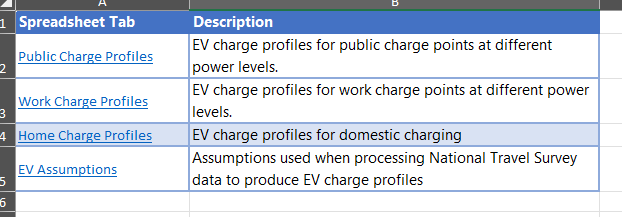
This dataset contains EV charge profiles for domestic and public charge points. Domestic charge profiles are represented as both ‘after diversity’ demands and as ‘typical' demand profiles for an individual charge point. After diversity demands represent the average charge profile across a large number of households. These will show a lower peak than the charge profile for an individual household since households will all have unique travel patterns and, therefore, will charge at different times of day.
Public and Work charge profiles represent the after diversity demand, but with an assumption that these charge points are used every day
Designed to aid Local Authorities in developing robust, evidence-based plans to enable Net Zero.
Already have an account? Login
 Guest preview of selected publicly available resourcesFull library of 1,000+ articlesCPD accredited e-learning coursesCase studiesDiscussion forum