
Outline of five case models adapted from the HM Treasury’s Five Case Model.
Resource
This is a test banner
Outline of five case models adapted from the HM Treasury’s Five Case Model.
Part of: HM treasury green book


The Five Case Model is the approach for developing business cases recommended by HM Treasury, the Welsh Government, and the UK Office of Government Commerce. It has been widely used across central government departments and public sector organisations over the last 10 years, as it offers a structured approach to presenting your project proposal for review and sign-off.
The Five Case Model provides a discipline and structure to arrive at the best possible decision. It is not a substitute for judgement and experience – these will always be required at various points in any decision-making process. It can be applied in a wide range of situations.
The Five Case Model is not a project management strategy, although it has elements that need to be considered in any management approach.
The Five Case Model and its associated business case lifecycle align with the Plan of Work, with the more mature business case aligning with a later stage in the project lifecycle.
The business case itself is developed through a lifecycle that creates a more mature and robust case at each stage.
To secure approval for a decarbonisation project, it is likely that you will need to submit a business case. Your organisation may have templates or guidance on what is required, and you should follow these where available. It is important to understand the requirements for your organisation and work with others to develop the business case.
Taking the time to develop a strong business case is a worthwhile investment of time within the project development process, as this will help to ensure:
Business cases are developed over the following three stages. The five elements of the Five Case Model – strategic, economic, commercial, financial, and management – should all be considered during each of these three stages of developing your business case.
The purpose of the SOC is to provide the necessary information in a format that will enable the authority and any public sector partners to assess the scope of the project and any investments in impact improvement.
This is developed during the strategic stage of the work.
The purpose of this stage is to revisit the options identified in the SOC, to identify the option that creates the most public value (‘the preferred option’) following more detailed appraisal, and to set out the possible deal while confirming affordability and putting in place the management arrangements for the successful delivery of the project.
This is developed during the planning and briefing phase.
The purpose of the FBC is to record the findings of the procurement phase and to identify the option that offers the ‘most economically advantageous tender’ (MEAT) and best public value. In addition, the FBC records the contractual arrangements, confirms affordability, and puts in place the agreed management arrangements for the delivery, monitoring, and post-evaluation of the project.
This is developed during the concept design and detailed design phase.
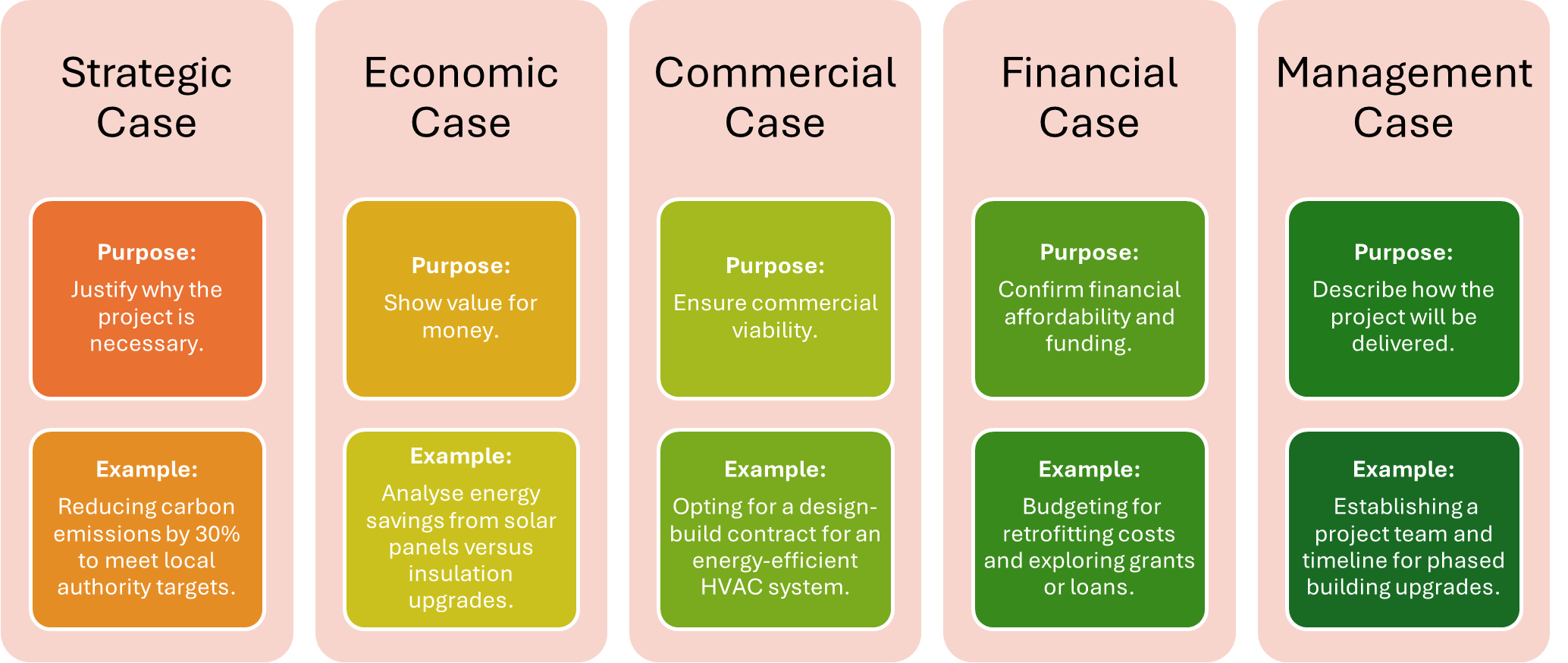
The below introduces the key characteristics of the five cases but is not intended as a comprehensive guide.
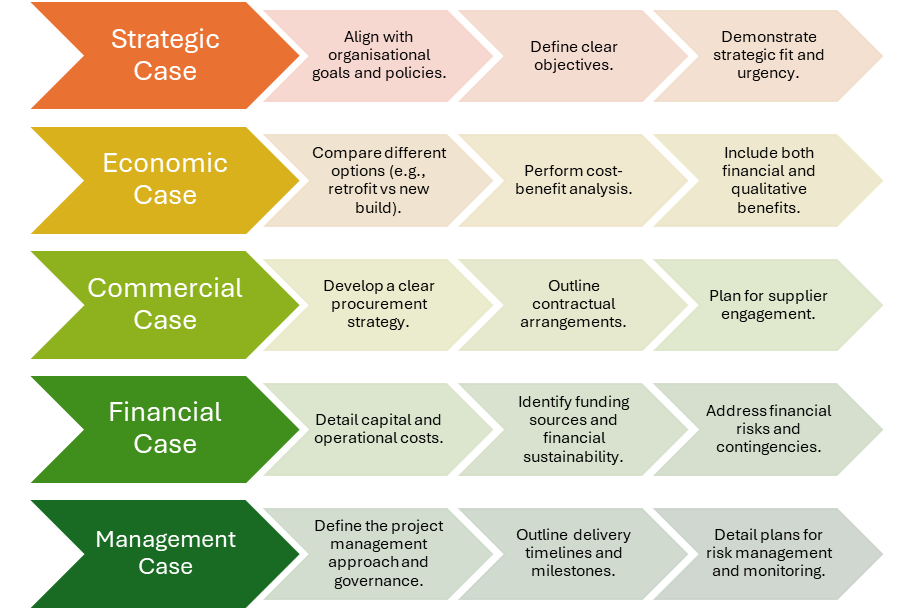
 The purpose of the strategic dimension of the business case is to make the case for change and to demonstrate how it provides strategic fit.
Demonstrating that the scheme fits with other projects and programmes within the strategic portfolio requires an up-to-date organisational business strategy that references all relevant local, regional, and national policies and targets.
Making a robust case for change requires a clear understanding of the rationale, drivers, and objectives for the spending proposal, which must be made SMART – Specific, Measurable, Achievable, Relevant, and Time-constrained – for the purposes of post-evaluation.
Key to making a compelling case for intervention is a clear understanding of the existing arrangements: the business as usual (BAU), business needs (related problems and opportunities), potential scope (the required organisational capabilities), and the potential benefits, risks, constraints, and dependencies associated with the proposal.
The challenges are:
 The purpose of the economic dimension of the business case is to identify the proposal that delivers best public value to society, including wider social and environmental effects.
Demonstrating public value requires a wide range of realistic options to be appraised (the longlist), in terms of how well they meet the spending objectives and critical success factors for the scheme, and then a reduced number of possible options (the shortlist) to be examined in further detail. The shortlist must include the BAU, a realistic and achievable ‘do minimum’ that meets essential requirements, the preferred way forward (if this is different), and any other options that have been carried forward.
These options are subjected to cost-benefit analysis (CBA), or cost-effectiveness analysis (CEA) where more appropriate, to identify the option that offers best public value to society. The challenges are to begin by selecting the ‘right’ options for scope, solution, service delivery, implementation, and funding, otherwise options will represent sub-optimal value for money (VfM) from the outset to justify higher cost options in relation to BAU and the ‘do minimum’ to measure and monetise the benefits and risks.
 The purpose of the commercial dimension of the business case is to demonstrate that the preferred option will result in viable procurement and a well-structured deal between the public sector and its service providers.
Demonstrating viable procurement requires an understanding of the marketplace, knowledge of what is realistically achievable by the supply side, and research into the procurement routes that will deliver best value to both parties. Putting in place a well-structured deal requires a clear understanding of the services, outputs, and milestones required to be achieved and how the potential risks in the design, build, funding, and operational (DBFO) phases of the scheme can best be allocated between the public and private sectors and reflected in the charging mechanism and contractual arrangements.
The challenge for the public sector is to be an ‘intelligent customer’, and to anticipate from the outset how best public value can continue to be secured during the contract phase in the face of inevitable changes to business, organisational, and operational requirements.
 The purpose of the financial dimension of the business case is to demonstrate the affordability and funding of the preferred option, including the support of stakeholders and customers, as required. Demonstrating the affordability and fundability of the preferred option requires a complete understanding of the capital, revenue, and whole-life costs of the scheme and of how the deal will impact the balance sheet, income and expenditure, and pricing arrangements (if any) of the organisation. The challenge is to identify and resolve any potential funding gaps during the lifespan of the scheme.
 The purpose of the management dimension of the business case is to demonstrate that robust arrangements are in place for the delivery, monitoring, and evaluation of the scheme, including feedback into the organisation’s strategic planning cycle.
Demonstrating that the preferred option can be successfully delivered requires evidencing that the scheme is being managed in accordance with best practice and subjected to independent assurance, and that the necessary arrangements are in place for change and contract management, benefits realisation, and risk management.
The challenges are:
It is important to remember that the five cases should be considered in a proportionate manner to the scale and complexity of the project; a single site with two measures proposed should not take as long to develop as a programme addressing 20 buildings.
Designed to aid Local Authorities in developing robust, evidence-based plans to enable Net Zero.
Already have an account? Login
 Guest preview of selected publicly available resourcesFull library of 1,000+ articlesCPD accredited e-learning coursesCase studiesDiscussion forum